Strategy stack: earn repeat use through trusted delivery
Connected dashboard practice: Defend the proposed North Star and distinguish hypotheses from arithmetic identities.
One decision
Proposal: validate a dependable localization-and-review workflow for enterprise training before committing to broad new production features. This is an interview thesis, not knowledge of DeepBrain AI's private priorities. The first conversation should test whether this customer and problem actually matter most.
| Level | Public fact or proposed interpretation | Decision evidence |
|---|---|---|
| Mission | Public: “AI for Human Life” | Company About page |
| Vision | Proposed: teams can communicate accurate content across languages without rebuilding every production | Discovery on repeated updates, quality and workload |
| Company objectives | Unknown internally; propose sustainable recurring customer value | Retained accounts, commercial retention and full service cost |
| Company strategy | Hypothesis: combine self-service reach with enterprise governance and workflow adoption | Observed product/pricing and sales surfaces; actual channel economics unknown |
| Product strategy | Proposed: make source → reviewed locale version → distribution reliable | Compare recovery, review burden, repeat use and alternatives |
| Product goals | Establish real baselines and choose a minimum worthwhile improvement with owners | No copied SORI target, no invented DeepBrain baseline |
| Roadmap | Instrument → bounded review/recovery prototype → paired evaluation → controlled pilot → mature-cohort decision | Gates below; sequence rather than promised dates |
| Delivery | Requirements FR1–FR6 → tests EV1–EV6 → named owner roles → monitored release | PRD and plan_gates; no actual release approval |
Company positioning, enterprise surface.
Choices and opportunity cost
Start with the training producer who must revise approved content across locales. Reuse rendering, identity and entitlements where feasible. Defer a new foundation model, autonomous publication, broad conversational-agent expansion and every requested avatar style. This narrows the initiative, not the company's entire strategy.
Alternative thesis: self-service conversion is the greatest constraint. If real data shows most lost value happens before first useful output because plan limits are confusing, prioritize entitlement clarity first. If existing enterprise users already complete localization reliably but lack demand, review investment may be wrong. Synthetic scenarios practice this trade-off; they cannot select the real strategy.
Metric relationships
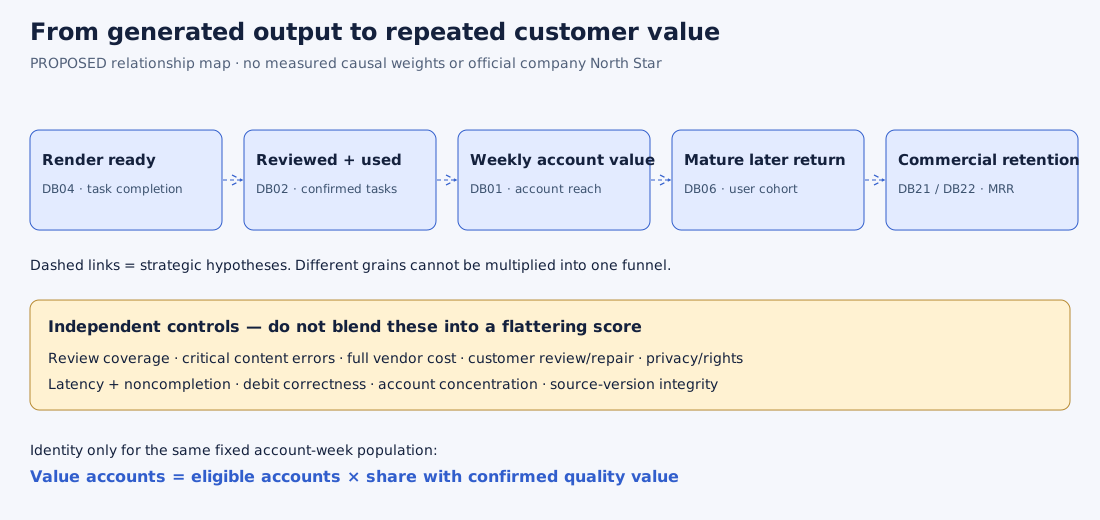
Proposed North Star DB01: weekly accounts with at least one quality-reviewed video version confirmed used in its intended workflow. Count each account once per UTC Monday–Sunday week; use timestamp determines week; approval must precede use. Report coverage of review and use confirmations. This selects an account unit suitable for B2B collaboration; solo creators can be one account. It does not equate viewers, seats, attempts or content versions.
Alternatives: generated minutes track load and meter usage, but can reward rework. Exporting users are a useful reach proxy but do not demonstrate use. Approved distributed versions are closer to useful work but can count many near-duplicates from one large account. Revenue is necessary for business health but can rise while workflows worsen. Keep these beside DB01 rather than blending them into an opaque score.
Arithmetic: for a fixed complete week and fixed eligible account set, confirmed-use accounts = eligible accounts × share with confirmed use. This identity is not a causal theory. The task funnel uses different units and cannot be multiplied into unique accounts without a cohort model.
Hypotheses: clearer entitlement → fewer avoidable blocks; version-bound review → fewer stale approvals; reliable completion → repeat use; repeat use → renewal. Observational slices can reveal associations. A randomized workflow test or defensible comparison is needed to estimate causal effect. Predicted return minus observed return is not causal lift.
Independent controls: critical errors/consent and privacy; completion coverage and missing reviews; full vendor cost plus customer labor; latency including review wait; support workload; account concentration and renewal. A larger North Star is not permission to relax these controls.
Roadmap and decision gates
- Discovery/measurement: inspect consented real tasks, source changes, buyer/user/operator handoffs, plan meters and existing traces. Agree definitions, data coverage and owners. Exit: a bounded problem and comparable baseline; stop if demand is weak.
- Prototype: one source, two locale versions, visible review state, clear usage estimate and recoverable async status. Use fictional or approved material. Exit: usability and feasibility evidence; prototype code is not production readiness.
- Offline validation: representative rights-cleared cases, paired versions, bilingual review, critical number/name tests, stale approval and tenant tests. Exit: critical tests resolved and quality/latency/cost trade-offs understood.
- Pilot: small explicit account cohort, opt-in/permissions, capped exposure, support/runbook and rollback. Experiment at account level to avoid team interference. Exit: completed useful work and total burden improve against pre-agreed criteria; no launch from a synthetic result.
- Repeat-value review: wait for the chosen mature observation window, investigate zero-use accounts and renewal reasons; retain calendar time for that follow-up. Scale, narrow or stop. A 90-day delivery plan cannot guarantee every late cohort has mature retention.
Operating cadence
Daily during a pilot: incidents, stuck tasks, debit reconciliation, review backlog and critical errors. Weekly: useful completion and coverage, persona/workflow slices, support and direct cost. Monthly: mature return, MRR bridge, GRR/NRR, acquisition efficiency and full cost. At each funding decision: one recommendation, strongest evidence, one material caveat, next test and reversal trigger.
Ownership: PM chooses customer problem and scope with sponsor; engineering owns feasibility/state/security; bilingual/domain reviewers own content rubric; analytics owns definitions; finance validates commercial accounting; CS owns recovery/support readiness. Actual names and authority remain open.