E23 · One elapsed-time story
Synthetic practice, not company performance.
One decision
Where is the customer's real wait?
Run the exact query
WITH b AS (SELECT * FROM v_task WHERE ('all'='all' OR persona='all') AND ('all'='all' OR workflow='all') AND ('all'='all' OR substr(signup_at,1,7)='all') AND date(created_at)>='2026-05-01' AND date(created_at)<'2026-10-01') SELECT workflow,COUNT(reviewed_at) reviewed_tasks,AVG((julianday(reviewed_at)-julianday(ready_at))*24) mean_ready_to_review_hours,SUM(confirmed_quality_use) useful_tasks,AVG(CASE WHEN confirmed_quality_use=1 THEN (julianday(confirmed_use_at)-julianday(created_at))*24 END) mean_created_to_use_hours FROM b GROUP BY workflow;
Download SQL · Result CSV · Metabase saved question
Chart and reading
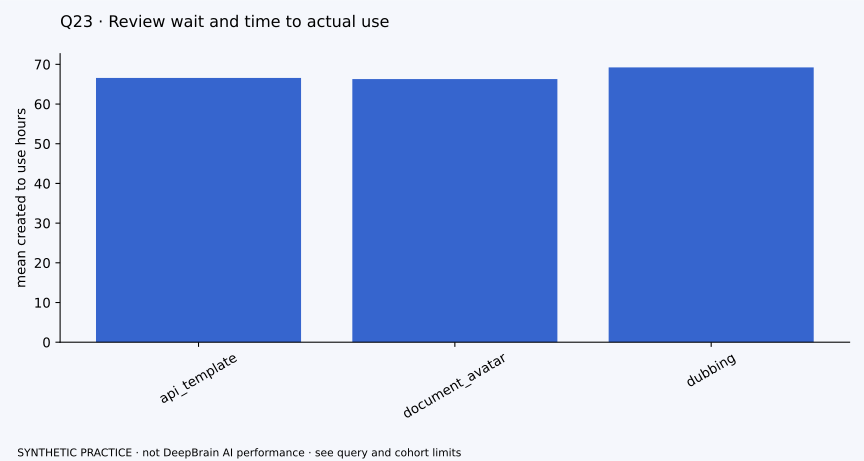
Distinguish ready-to-review wait, active work and total time to use.
Challenge your recommendation
Are unconfirmed long tasks censored?
Guardrails: Different completed populations in each duration; missing review/use may censor long waits.
Next evidence: Incomplete durations, reviewer staffing and end-to-end observation.
PRD sections: 6, 11, 14. Open proposed PRD
Your spoken decision
State one takeaway, one caveat and one action in 30 seconds. Then stop.
Connect this finding
What this chart helps decide · Follow the connected decision · Canonical metric definitions
Optional model answer — try your own first
E23 · One elapsed-time story
Decision: Where is the customer's real wait?
Readout: Distinguish ready-to-review wait, active work and total time to use.
Actual query output (synthetic), first rows:
| workflow | reviewed_tasks | mean_ready_to_review_hours | useful_tasks | mean_created_to_use_hours |
|---|---|---|---|---|
| api_template | 187 | 32.44099821773841 | 79 | 66.58607594980091 |
| document_avatar | 172 | 31.537596898738208 | 62 | 66.29142025053021 |
| dubbing | 158 | 30.0413502110522 | 43 | 69.23625323089749 |
Model spoken answer: I would compare machine and human waiting before investing in faster inference.
Caveat/counterargument: Are unconfirmed long tasks censored? Different completed populations in each duration; missing review/use may censor long waits.
Next evidence: Incomplete durations, reviewer staffing and end-to-end observation.
Deliberately left out: Adding mean waits from different task populations.