E18 · Full economics
Synthetic practice, not company performance.
One decision
Can the service sustain this workload?
Run the exact query
WITH billing AS(SELECT month,SUM(cash_received-refunds) net_cash,SUM(payment_fee) payment_fee FROM sim_billing GROUP BY month),costs AS(SELECT substr(t.created_at,1,7) month,SUM(c.cost_usd) direct_usd FROM sim_costs c JOIN sim_tasks t USING(task_id) GROUP BY 1),fixed AS(SELECT month,SUM(CASE WHEN component<>'research_and_development' THEN cost_usd ELSE 0 END) service_allocated,SUM(CASE WHEN component='research_and_development' THEN cost_usd ELSE 0 END) rd FROM sim_period_costs GROUP BY month) SELECT b.*,COALESCE(c.direct_usd,0) direct_usd,f.service_allocated,f.rd,b.net_cash-b.payment_fee-COALESCE(c.direct_usd,0)-f.service_allocated service_cash_contribution,b.net_cash-b.payment_fee-COALESCE(c.direct_usd,0)-f.service_allocated-f.rd after_rd_cash_proxy FROM billing b LEFT JOIN costs c USING(month) JOIN fixed f USING(month) WHERE month>=substr('2026-05-01',1,7) AND month<substr('2026-10-01',1,7) ORDER BY month;
Download SQL · Result CSV · Metabase saved question
Chart and reading
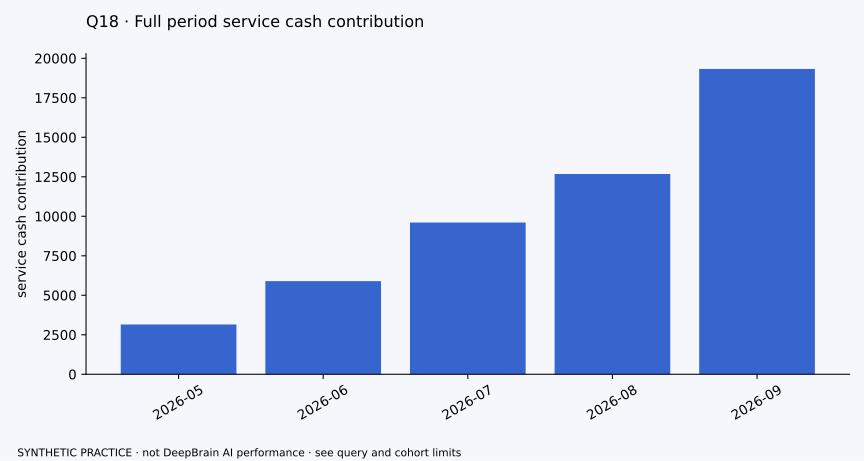
Preaggregate billing, task costs and period allocations separately before joining month.
Challenge your recommendation
Which costs and cash timing remain excluded?
Guardrails: Not recognized gross margin or profit; customer labor, acquisition and unmodeled overhead excluded. Task-cost month is task creation convention.
Next evidence: Acquisition, overhead, recognition policy and provider commitments.
PRD sections: 2, 14, 17. Open proposed PRD
Your spoken decision
State one takeaway, one caveat and one action in 30 seconds. Then stop.
Connect this finding
What this chart helps decide · Follow the connected decision · Canonical metric definitions
Optional model answer — try your own first
E18 · Full economics
Decision: Can the service sustain this workload?
Readout: Preaggregate billing, task costs and period allocations separately before joining month.
Actual query output (synthetic), first rows:
| month | net_cash | payment_fee | direct_usd | service_allocated | rd | service_cash_contribution | after_rd_cash_proxy |
|---|---|---|---|---|---|---|---|
| 2026-05 | 3835.95 | 111.36 | 205.595464 | 366.52 | 1164.58 | 3152.4745359999997 | 1987.8945359999998 |
| 2026-06 | 6986.94 | 202.7622 | 608.602736 | 279.27 | 1347.57 | 5896.305064 | 4548.735064 |
| 2026-07 | 11032.8 | 327.0505 | 754.062304 | 347.08000000000004 | 1399.86 | 9604.607195999999 | 8204.747195999998 |
Model spoken answer: I would present the service cash-contribution proxy with its exclusions, not call it profit.
Caveat/counterargument: Which costs and cash timing remain excluded? Not recognized gross margin or profit; customer labor, acquisition and unmodeled overhead excluded. Task-cost month is task creation convention.
Next evidence: Acquisition, overhead, recognition policy and provider commitments.
Deliberately left out: A precise company margin estimate from practice numbers.