E05 · Signal versus cause
Synthetic practice, not company performance.
One decision
Does activation cause later return?
Run the exact query
WITH b AS (SELECT * FROM v_user_cohort WHERE ('all'='all' OR persona='all') AND ('all'='all' OR primary_workflow='all') AND ('all'='all' OR substr(signup_at,1,7)='all') AND date(signup_at)>='2026-05-01' AND date(signup_at)<'2026-10-01') SELECT activated7 early_value,COUNT(*) mature_users,SUM(return28_41) later_return,100.0*AVG(return28_41) return_pct FROM b WHERE mature42=1 GROUP BY activated7;
Download SQL · Result CSV · Metabase saved question
Chart and reading
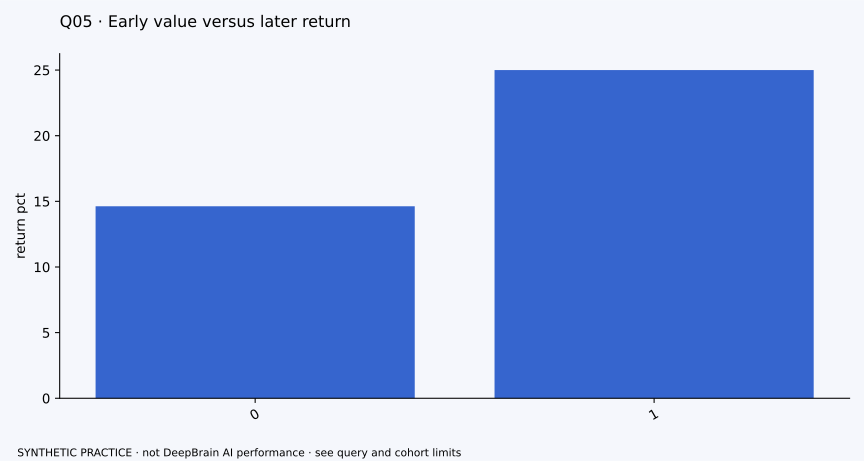
Explain the association and a future account-randomized intervention.
Challenge your recommendation
Could initial intent or account mix cause both?
Guardrails: Descriptive association; intent, account mix and confirmation coverage may explain it.
Next evidence: Assignment unit, sample/power, coverage and a disconfirming test.
PRD sections: 12, 14. Open proposed PRD
Your spoken decision
State one takeaway, one caveat and one action in 30 seconds. Then stop.
Connect this finding
What this chart helps decide · Follow the connected decision · Canonical metric definitions
Optional model answer — try your own first
E05 · Signal versus cause
Decision: Does activation cause later return?
Readout: Explain the association and a future account-randomized intervention.
Actual query output (synthetic), first rows:
| early_value | mature_users | later_return | return_pct |
|---|---|---|---|
| 0 | 212 | 31 | 14.622641509433961 |
| 1 | 12 | 3 | 25.0 |
Model spoken answer: Early value is associated with later return in this fictional panel; I would test a specific onboarding change before claiming causality.
Caveat/counterargument: Could initial intent or account mix cause both? Descriptive association; intent, account mix and confirmation coverage may explain it.
Next evidence: Assignment unit, sample/power, coverage and a disconfirming test.
Deliberately left out: Predicted-minus-observed residuals as a supposed causal estimate.